WEATHER RECORD BOOKS
  • Home - Choose Station
  • the data
    • Winnipeg metadata
    • Symbols
    • Quality Control
    • Weather Elements
    • Definitions
  • Contact / About me
  • Southdale
  • Monthly Summaries
  • Blog

JUNE Daily Precipitation Records - WINNIPEG (since 1873)

Day

   High rainfall

  High snowfall

   High Precip

Day

1

43.7

1873

T

1985 PL

43.7

1873

1

2

32.8

1990

1.3

1875 C

32.8

1990

2

3

54.0

2023

T

1935

54.0

2023

3

4

49.0

1934

T

1935

49.0

1934

4

5

54.6

1996 D

0.0

54.6

1996 D

5

6

38.5

2008

T

1901 C

38.5

2008

6

7

32.5

1936

T

1915*

32.5

1936

7

8

31.0

1984

0.5

1877

31.0

1984

8

9

33.8

2021

0.0

33.8

2021

9

10

41.7

1883 O

0.0

41.7

1883 O

10

11

20.2

1988

0.0

20.2

1988

11

12

52.2

1989

0.3

1969

52.2

1989

12

13

44.2

1919

0.0

44.2

1919

13

14

43.2

1879

0.0

43.2

1879

14

15

40.1

2014

0.0


40.1

2014

15

16

60.1

1984

0.0

60.1

1984

16

17

41.4

1906

0.0

41.4

1906

17

18

52.3

1964

0.0

52.3

1964

18

19

30.5

1928

0.0

30.5

1928

19

20

36.6

1953

0.0

36.6

1953

20

21

69.8

1984

0.0

69.8

1984

21

22

54.4

1975

0.0

54.4

1975

22

23

33.3

1916

0.0

33.3

1916

23

24

55.7

2022

0.0

55.7

2022

24

25

63.6

1991

0.0

63.6

1991

25

26

152.4

1901

0.0

152.4

1901

26

27

48.3

1944 D

0.0

48.3

1944 D

27

28

37.6

1945

0.0

37.6

1945

28

29

43.5

2005

0.0

43.5

2005

29

30

60.7

1968

0.0

60.7

1968

30


data sources and flags
  • ​​​The climate day for daily precipitation is 06z-06z from July 1961 to present. Prior to July 1961, the climate day was primarily approximately 12z-12z. However, when enough evidence could be found, I have modified the climate day to approximately 06z-06z pre-1961 (''D'' flag). 
  • Until December 31, 1976, all measurements were taken in imperial units. Starting January 1, 1977, all measurements were taken in metric units. All historical data in imperial units have been converted to metric units, however, ECCC rounded the values to the nearest tenth of an inch before converting to cm or mm. This rounding resulted in slightly less precision in some cases where additional precision was available. ​
  • The ECCC Archives are the main source of data for daily precipitation, using the stations:
    • ​Winnipeg Airport CXWG from October 2013 to present. 
    • Winnipeg Airport CYWG AWOS from July 2008 to October 2013. 
    • Winnipeg Airport CYWG from 1938 to July 2008. 
    • St John's College from 1872 to 1937. See Rob Paola's blog post for a history of locations for this station. ​​​
  • Additional data sources for snowfall:
    • Weatherlogics - for daily snowfall from October 2022 to present. Measurements are taken in small field behind the Waverley Fire Hall. 
    • Charleswood - for daily snowfall from January 2003 to May 2022. From November 2004, the measurements are from the ECCC Archives (12z-12z climate day). Prior to November 2004, they are from the observer's private website (Rob Paola) (06z-06z climate day). Note that these measurements were in a private residential backyard and may be slightly higher than what would be observed at the Airport (though the effect on snowfall is lesser than for snow depth). 
  • Starting July 2008, daily rainfall was no longer recorded at the Airport. I have created estimates as a result, using weather observations from CYWG as reference to determine if the precipitation recorded fell as rain or snow. On days when it was well above freezing, it was clearly rain with no ambiguity. However, on days with mixed rain and snow, the estimate becomes more complicated. An ''E'' flag is used in these cases with more information provided in the data notes section. Note that in my estimates, I do not consider ''snow melting on contact'' to be rainfall. However, historically I have found that ECCC may consider it as rainfall, giving inflated rainfall amounts. In extreme cases of this, a ''SN'' flag is used. This flag is also used in cases where ''snow melting on contact'' was entered at a 10:1 ratio with precipitation. I have found a few cases of this in the past, where snowfall amounts were inflated (due to a false assumption of 10:1 ratio). 
  • CXWG (2013-present) tends to under catch snowfall in the winter, resulting in artificially low precipitation amounts in the winter months. I have attempted to account for this slightly by using The Forks (ECCC Archives) as a replacement, which is a more sheltered station with less under catch. The ''U'' flag is used for these instances. Sometimes I have used the Weatherlogics measurements if The Forks also significantly under caught snowfall. Note that these corrections are to improve upon the amounts, but not fully fix them. More complicated calculations would have to be made to fully correct them. 
  • CYWG AWOS (2008-2013) nipher shield issues often caused inflated rainfall amounts in the winter months (double what actually fell). CXWG, The Forks or Charleswood were used as replacement in some of these instances. The ''E'' flag is used for these. 
  • The ''A'' flag is used in cases where a 2-day precipitation amount was entered on a single day, but I could not find enough information to divide the amount into the appropriate two days. 

​​​​​​​​
data notes
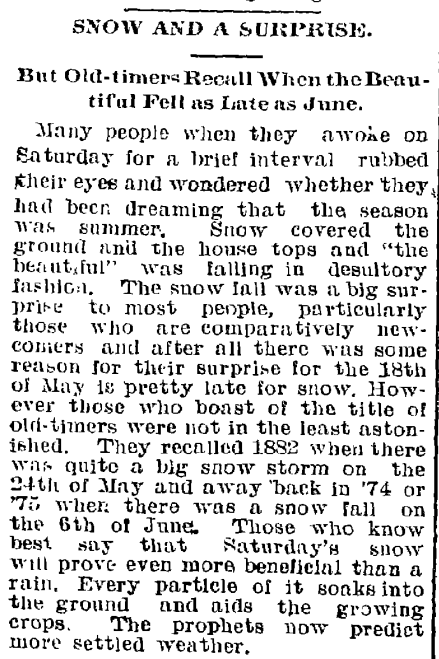
June 2, 1875 snowfall: Originally was entered on June 1st, but appears to be the wrong date given a low temperature of 10.0°C. The Winnipeg Free Press published a general meteorological register for 1875 which showed snow and sleet on June 2nd, which makes more sense given the temperatures. I have moved the snowfall to the 2nd as a result. A newspaper article in 1895 mentioned snow on June 6th (I'm not sure of the accuracy of this date) in either 1874 or 1875, which may be referring to this snowfall event, but does not appear to be the correct date either. 
June 9-10, 1883 - The rain amounts in the ECCC Archives do not at all match the observer notes from St John's College retrieved at the Library and Archives of Canada in Winnipeg from June 9 to 18, 1883. The observer notes show no rain at all on June 9 and 41.7 mm on June 10, which actually corroborates more closely with St Andrews. Newspapers also describe a heavy thunderstorm in the evening of June 10 which caused washouts in the streets. This would corroborate the 41.7 mm of rain in the observer notes for the date (ECCC only has 0.5 mm). This heavy thunderstorm evidence in newspapers was the supporting piece of evidence that led me to accept the observer notes rainfall amounts. Note that St Boniface College reported almost 50 mm of rain on the 10th, providing more evidence that the ECCC Archives amounts are suspicious. 

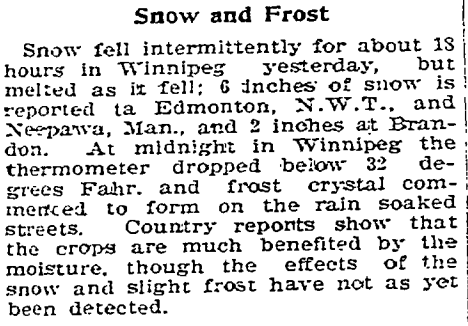
June 6, 1901 snowfall - The Morning Telegram on June 7, 1901 said ''snow fell intermittently for about 18 hours in Winnipeg yesterday, but melted as it fell''. This observation is supplemented by reports in newspapers of snow at Stonewall and Morris. EC Archives also have snow at Stony Mountain and Oakbank. Given all this information, I have added a trace for June 6, 1901 (given the report of all snow melting as it fell). 
June 15, 1903 - Trace snow on June 15 eliminated because it appears to be erroneous. The observer at St John's College did not record any snow according to their notes. Newspapers don't mention any snow. It just so happens to be the only station in Manitoba that ECCC has snow that June as well. All raises suspicions. 
June 1, 1985 - Ice pellets fell, not snow. Evidenced by raw data retrieved from NOAA which showed a weather code of MW79 which is used for ice pellets. In addition, the Environment Canada meteorological summary showed ice pellets. I believed it is possible it was small hail or graupel that fell given temperatures near 8°C. 
June 4, 1985 - Trace snow eliminated because it was small hail or maybe graupel that fell, not snow. Raw data retrieved from NOAA showed a weather code of MW87 which is used for small hail or snow pellets OR rain and snow mixed, but with a dewpoint of 9°c at the time, it was likely small hail associated with convection. 
June 5, 1996 - 11.8 mm entered on the 4th actually fell on the 5th overnight. The amount is added to the 5th as a result to preserve a midnight-midnight climate day. 
June 27, 1944 - 48.3 mm fell from 130am the 27th to 130am the 28th. This is as close to 06z-06z as is calculatable. EC Archives originally have 45.2 mm from 730am to 730am. 
​
other possible records
June 6, 1871 - An unofficial record rainfall of 44.5 mm. Found in the Manitoban and Northwest Herald.
Back to Winnipeg Weather Records


Graph form:

Powered by Create your own unique website with customizable templates.